Making Native Title Governance Legible
4 MIN READ
Two engagements with the same organisation, one planned, one urgent. Both required the same discipline: translating complex governance information into something a dispersed community could understand and trust.
Governance Communication • First Nations Community • Service Design • Information Design • Stakeholder Communication • Editorial Judgment


DENSE
140
LEGIBLE
MEMBERS
24
HOURS
ENGAGEMENTS
2
Role: Independent advisor and design lead, governance communication | Engaged by: Carpentaria Land Council Aboriginal Corporation | Client: Gkuthaarn Kukatj Aboriginal Corporation | Timeline: October 2025 – June 2026
When Governance Communication Has Real Stakes
Prescribed Bodies Corporate (PBC) carry significant responsibilities under Native Title legislation — managing land ownership, governance obligations, community relationships and federal compliance requirements. For a community accessing the formal structures to govern their own country, the quality of communication is not incidental. It determines whether members can meaningfully participate in decisions that affect them.
Gkuthaarn Kukatj Aboriginal Corporation operates in that context. Engaged twice through Carpentaria Land Council Aboriginal Corporation across two distinct moments eight months apart, I worked on governance communication that mattered, first in preparation, then under pressure.
The First Brief: Clarity Before the Room (October 2025)
The immediate need was a slide deck for an upcoming AGM. The material needed to work for Board members navigating governance responsibilities, and for broader community stakeholders, including people in a remote community accessing the formal structures to govern their own country for the first time.
These two audiences have different starting points, different levels of familiarity with governance language, and different needs from the same content. The challenge was to structure the material so it could serve both without requiring two separate documents, and without oversimplifying the governance substance in ways that would undermine its credibility with the Board.
My role:
I worked from the source governance material analysing content, identifying the underlying narrative logic, and restructuring information into a clear, sequenced flow. The emphasis was on translation rather than formatting: restructuring content around what the audience needed to understand rather than what the documentation required to say, simplifying visual hierarchy so the material supported discussion rather than overwhelming it, and building in enough structural clarity to hold weight in both a Board setting and a community one.
What was produced:
A slide deck for the AGM, and a reusable template the organisation could adapt for future governance and training sessions. A communication resource GKAC could genuinely own and operate without ongoing external input.
What followed:
The material did what well-structured governance communication should, it got out of the way. The Board was able to focus on the substance of the agenda rather than navigating the information itself. Discussion moved. Decisions were made. Resource allocation was agreed, unlocking funding and enabling commitments to community initiatives that had been waiting on this governance process to proceed.
For a community finally exercising agency to govern its own country, that outcome is not administrative. It is what the work was for.
The Second Brief: Twenty-Four Hours (June 2026)
Eight months later, a governance crisis required urgent communication to 140 members of the corporation, many of them geographically dispersed, many receiving this communication as a physical mail-out in a remote northern Queensland community.
The challenge extended well beyond speed. The communication needed to cut through misinformation circulating in the community, re-establish trust in the Board's leadership, and deliver complex financial and governance information in a way that was clear, calm and accessible.
For a First Nations corporation operating under the CATSI Act, member trust is not a communications goal, it is a governance requirement.
My role:
Designer, editor and production manager simultaneously, across a 24-hour window with no margin for sequential working. Source content was rewritten, reframed and proofed for tone, accuracy and political sensitivity throughout, while editorial judgment ran alongside design at every stage, not after it. Print constraints shaped every decision: background treatments, safe margins and colour management were all calibrated for in-house colour laser printing under real-world conditions. Client questions were resolved in real time to keep the build moving.
What was produced:
A four-panel A3 colour newsletter, folded to A4 for posting, covering organisational achievements, new business ventures, grant funding outcomes and a transparent financial update. A branded member letter from the Board of Directors. An InDesign newsletter template as a reusable asset for future member communications. All produced within the established GKAC brand system and adapted for practical production constraints.
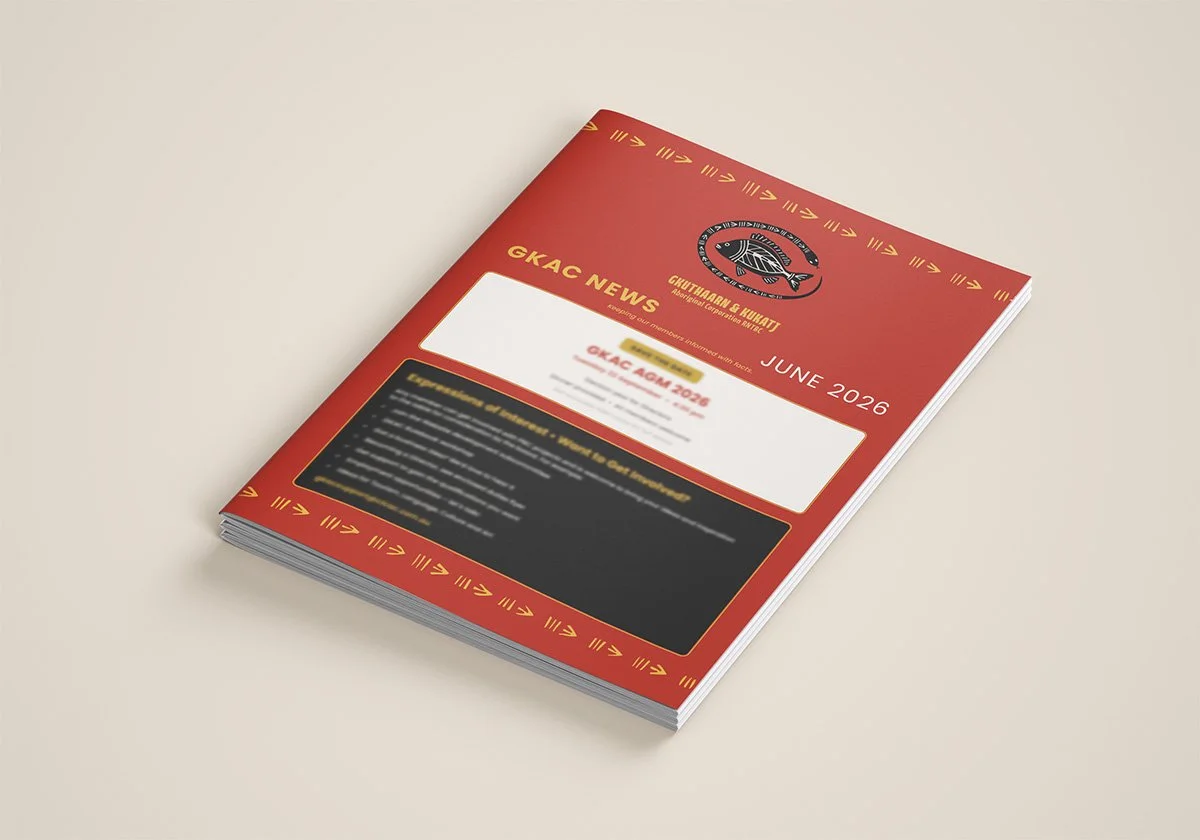
GKAC News — June 2026 member newsletter. Designed and produced within 24 hours for distribution to 140 members of Gkuthaarn Kukatj Aboriginal Corporation across a geographically dispersed community.
“Paula has a real ability to bring clarity to complex information. She helped us translate detailed governance material into clear, structured communication that worked for both our Board and the broader community. The result is something we continue to use to support governance and training across the organisation.”
What Carries Across Both Engagements
The two briefs were different in scale, urgency and format. What remained constant was the discipline required to operate in a governance-sensitive environment: understanding what the communication needs to carry, who it is for, and what it must not get wrong.
That discipline — translating complex source material for specific audiences, maintaining editorial judgment alongside production under pressure, designing for reuse and long-term organisational utility — is transferable across any context where the clarity of communication carries real consequence. Policy settings, regulated industries, enterprise transformation, community-facing service design.
The stakes change. The discipline doesn't.
The relationship with the organisation has continued. That continuity is its own form of evidence.