Retailer Lifecycle Architecture: Mapping Experience to Retention
6 MIN READ
Qualitative Field Research • Lifecycle Journey Architecture • Emotional Signal Mapping • Competitive Benchmarking • Experience-Driven Retention Insight
Retailer trust doesn’t break at renewal.
It erodes stage by stage, and sixteen weeks of qualitative research made that visible enough to act on.

FRAGMENTS
5 stages
COMPLETE PICTURE
RETAILER LIFECYCLE

16 weeks
Board-level
RESEARCH PROGRAM
DELIVERY
Role: Research Consultant / Senior Designer | Team: 3 Researchers | Project Type: Qualitative Experience Research & Lifecycle Analysis | Client: Vicinity Centres
Beyond the Satisfaction Score
Vicinity Centres (ASX:VCV) manages $26 billion in retail assets across 64 shopping centres, including Chadstone, making it the second largest listed manager of retail property in Australia.
ACRS had run annual TenSAT and CentreSAT tracking for Vicinity Centres since 2017 and 2018, alongside a qualitative research program that had, until this point, run biannually. This wave marked a shift to a yearly cadence: a second-stage qualitative deep dive, commissioned to build a systems-level view of the retailer journey, showing how experience across five lifecycle stages shaped long-term relationships and renewal intention, and extending prior waves with syndicated competitor data.
From Interview Room To Boardroom
Research Consultant / Senior Designer, ACRS / Monash University.
One of three researchers on the qualitative fieldwork
Coded and themed qualitative data across five lifecycle stages
Contributed to collaborative insight synthesis workshops
Sole owner of the lifecycle journey architecture and emotional trend mapping
Designed the final Board-ready research report and the C-suite presentation deck
Presentation delivered by senior leadership
Where the Numbers Ran Out
TenSAT and CenterSAT tracked sentiment across tenants, shoppers and renters, but the metrics alone couldn’t explain:
How experience signals accumulated across lifecycle stages,
Where trust and friction were entered the relationship,
Why certain drivers mattered more to renewal than others, and
How Vicinity compared structurally to competitor landlords.
What Was Actually at Stake
The real challenge: turn qualitative insight into lifecycle intelligence, connecting experience architecture to retention outcomes within an established longitudinal framework.
Renewal intention wasn't an abstract metric, either. It sits directly against account managers' and the leasing team's KPIs, tied to their annual remuneration. Getting the drivers right had a real financial consequence for real people, not just a line in a strategy deck.
There was another layer to it. ACRS sits inside Monash Business School, a research unit that answers to academic rigour: defensible coding, longitudinal consistency, methodology that would hold up to scrutiny. Vicinity needed something the leasing team could act on that quarter, tied plainly to renewal intention and commercial outcomes. Neither side of that tension could be dropped to satisfy the other.
From Transcripts to Architecture
1. Field Research Across the Retailer Lifecycle
As part of a three-researcher team, I conducted a share of 25 in-depth qualitative interviews with head-office and centre-level retailers, spanning all five lifecycle stages, from pre-sales through to renewal and termination.
Interviews captured both strategic leasing perspectives and day-to-day operational realities, so the dataset reflected executive and frontline signals alike.
2.Qualitative Coding & Systems Synthesis
I coded transcripts and identified recurring patterns across stages: friction accumulation, emotional inflection points, trust and relationship signals, and operational breakdown. Working with the Research Director and the Senior Researcher, I connected these patterns to the broader satisfaction data and competitor benchmarks, turning narrative accounts into structured lifecycle intelligence.
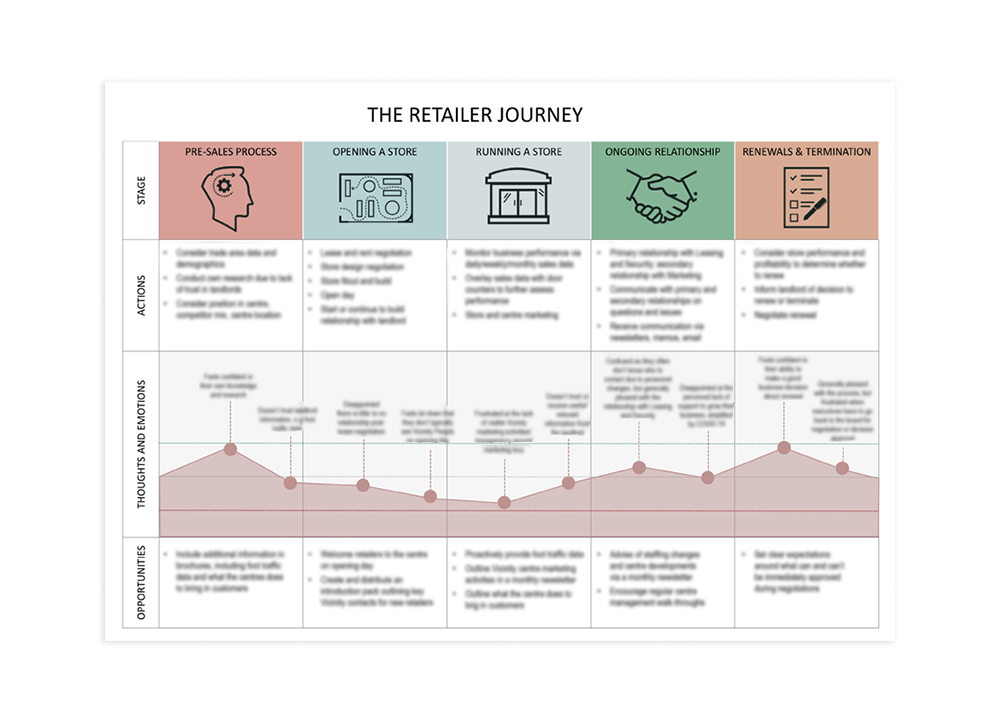
Retailer lifecycle architecture mapping behavioural actions, emotional signals and opportunity zones across five defined stages.
3. Journey Architecture & Executive Artefact Design
The coded data supported far more nuance than any Board presentation could hold. The real decision wasn't what to include, it was what to leave out without losing the rigour behind it: which patterns were strong enough, and commercially relevant enough, to survive the cut down to a handful of prioritised, renewal-linked drivers senior leadership could act on.
I translated the synthesised insights into a structured lifecycle journey model: mapping stage-based actions, emotional trajectory over time, critical experience drivers, and the opportunity zones with the greatest influence on renewal intention. I then designed and structured the final Board-ready research report and the C-suite presentation deck around that smaller set of defensible, actionable drivers. delivered the final executive presentation.
From Scores to Signals
This program has a track record of changing how Vicinity operates, not just what it reports. Vicinity's Customer Intelligence team has credited the qualitative research with establishing the link between retailer satisfaction and renewal intention, a finding that now shapes internal communication about how satisfaction improvements translate into commercial outcomes. It has also been used to fine-tune how often the business communicates with head-office retailers, and to give retailer-facing teams concrete, driver-specific direction rather than a general sentiment score.
This wave specifically:
Showed how experience signals accumulated across five retailer stages
Identified the structural drivers influencing renewal intention
Contextualised findings against competitor landlord benchmarks
Shifted internal focus from broad satisfaction scores to stage-specific experience levers
The final report translated qualitative lifecycle insight into a structured narrative aligned with Vicinity's broader strategic objectives. It was built to brief a Board, not just report findings.
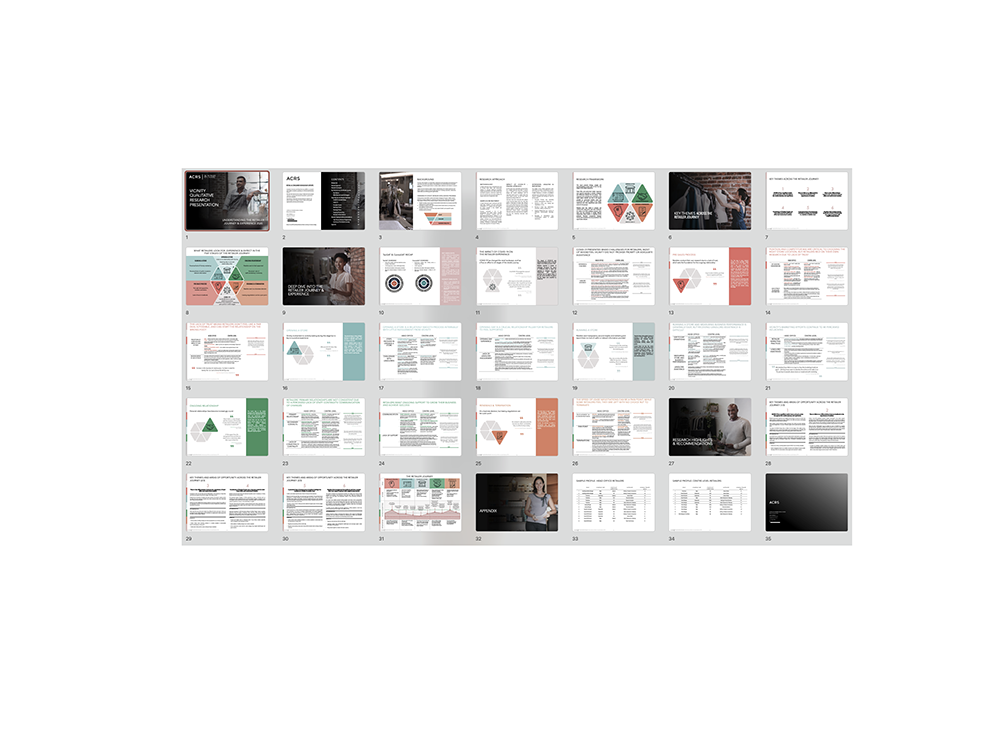
Executive research artefacts translating qualitative lifecycle insight into structured, Board-ready recommendations.
What Erosion Looks Like
Lifecycle experience is rarely shaped by a single moment. It accumulates. Retailer sentiment was set long before renewal conversations even began: friction introduced at leasing or store opening kept surfacing months, sometimes years, later.
The most valuable outcome for me wasn't the finding itself. It was proof of a way of working. When qualitative narratives are mapped as a system rather than a sequence of touchpoints, organisations gain clarity on where to focus, not just what to measure.
*Selected artefacts have been simplified for portfolio presentation.