What Australian’s Think About Retirement.
And What That Means for a New Financial Product
Co-Design Research • Behavioural Insight • Qualitative Synthesis • Service Design • Financial Services
5 MIN READ
You can't test a product people aren't ready to consider.
The first phase of this research was about earning that readiness.


PARTICIPANTS
FRAGMENTS
22
SYNTHESIS
MINUTE INTERVIEWS
60 – 90
RESEARCH PROGRAM
2-phase
Role: Research interviewer • Qualitative synthesis • Report and presentation design | Team: ACRS, Monash Business School – 4 person research team | Timeline: June – November 2017 | Client: Australian Super
The Problem Before the Product
AustralianSuper had a hypothesis. Australians aged 65 and older collectively hold more than $500 billion in home equity, while many face the real risk of outliving their superannuation savings. A home income product — drawing on that equity as an ongoing income stream — could address that gap. But before developing a product, they needed to understand whether Australians would consider it, and why or why not.
That question couldn't be answered directly. People don't evaluate financial products in isolation. They evaluate them against their values, their fears, and what those products would cost them emotionally, not just financially. So the research program was built to work backwards: understand the person before you introduce the product.
Two Phases, Deliberately Sequenced
Phase 1 set product questions aside entirely. The goal was to understand the psychological, behavioural, social and cultural factors shaping how Australians think about retirement — how they plan, what they worry about, what they're protecting. Phase 2 then introduced the home equity concept, grounded in that understanding.
Each phase began with pre-testing — two interviews to validate the discussion guide before main fieldwork began. All interviews were conducted in-person at participants' homes and ran 60 to 90 minutes. The sample across both phases included retirees, pre-retirees and reverse mortgage holders, recruited to a detailed specification across age, financial literacy, AustralianSuper membership status and household composition.
The Collage Came First
Before Phase 1 participants were interviewed, they received a pre-interview task: create a collage — physical or digital — representing what retirement means to them. Thoughts, feelings, activities, relationships. The brief was deliberately open.
What came back was consistent across nearly every participant. Retirement, for Australians, is about continued growth, experiences and relationships. Travel. Grandchildren. Health. Time. The word that appeared least often was money.
That task did something a direct question couldn't: it surfaced the emotional landscape before the conversation began. And it set up a critical insight — the home in that picture wasn't a financial asset. It was a family asset, tied to identity, legacy and belonging.
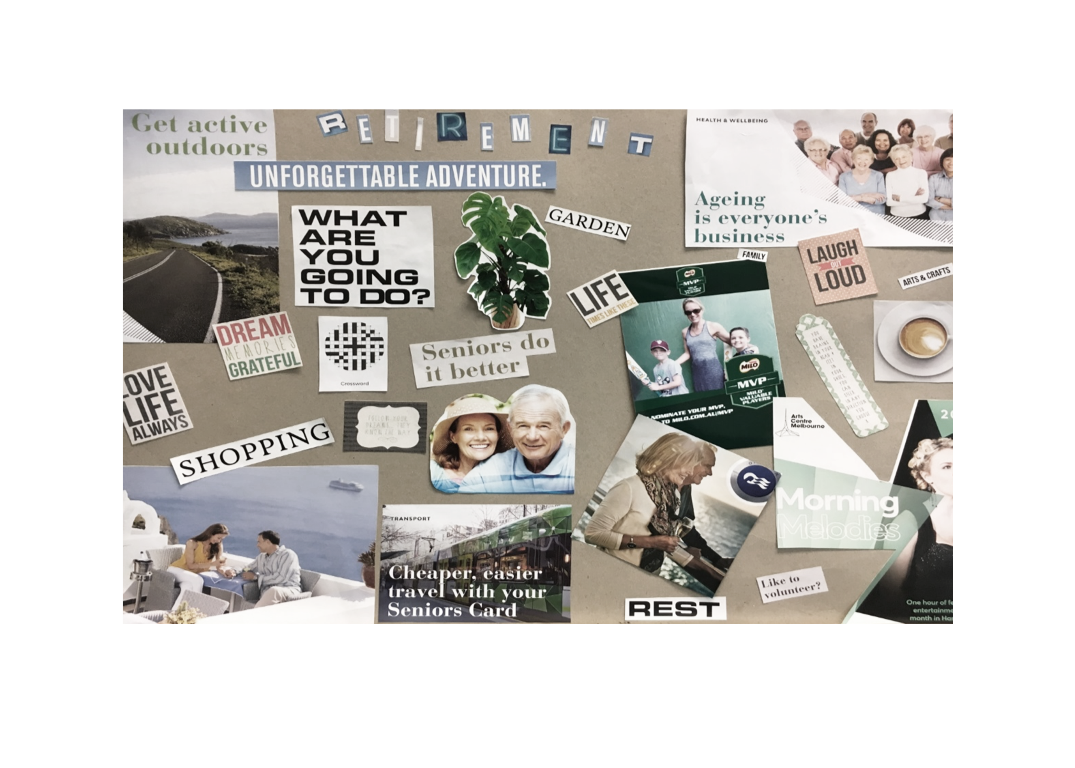
Participant collage artefact from Phase 1 pre-interview task. The assembled magazine images and text reflect retirement as a time of continued growth, relationships and experience.
“Financial peace of mind is what will be my most important need in retirement.”
"I Would Never." — And Why That Was the Starting Point
When Phase 2 introduced the concept of releasing home equity — without framing or guidance — the reaction was visceral. Participants described it as risky, selfish, desperate. A last resort. Something you did when everything else had failed. The resistance wasn't rational. It was deeply emotional, rooted in values around debt, legacy and what the home means to a family across generations.
That reaction was exactly what the research needed to surface. Because emotional barriers are different from rational ones. They can be addressed — but only with the right framing, introduced at the right moment, and in a guided rather than open-ended way.
What Changed When the Numbers Came Out
Phase 2 included guided retirement scenario testing: illustrated, side-by-side comparisons of two options — downsizing versus a home income product — showing projected financial outcomes over 10 years for single and double households, with supporting assumptions clearly set out.
When participants worked through the scenarios step by step, the reaction shifted considerably. The vast majority developed a clear preference for the home income option. It allowed them to remain in their home. The projections were financially favourable. And crucially, when presented as a structured income strategy rather than a debt product, it no longer triggered the same emotional resistance.
The research identified what a viable product would require: a home income framing rather than a reverse mortgage label, flexible and personalised drawdown options, simple and clear communication, education before product, and AustralianSuper's trusted brand positioned as the right provider to offer it.
Making 75 Pages of Research Legible
As part of the four-person ACRS research team, I conducted participant interviews across both phases, contributed to qualitative insight synthesis, and took primary ownership of the final report and executive presentation.
Senior researchers led the analytical framing and wrote the substantive content. My role was to take that material — across two phases, 22 participants, multiple insight themes and a complex set of product implications — and produce a report that AustralianSuper's executive team could navigate, understand and act on.
That meant designing a structured, coherent document that held together across 75+ pages: clear visual hierarchy, consistent information architecture, well-integrated participant verbatims, and an executive summary that distilled the key findings without losing their nuance. The research director presented to the client. My job was to make sure the work was in the best possible shape before it entered that room.
What This Work Demonstrates
This project sits at the intersection of co-design research and research translation.
The methodology — understanding people before introducing a product — is a disciplined approach to service design thinking: you earn the right to ask the hard question by first establishing what matters to the people you're asking it of.
It also demonstrates what happens after the insight: structuring, designing and producing research outputs that make complex findings accessible to the people who need to make decisions from them. The research is only as useful as the document that carries it.